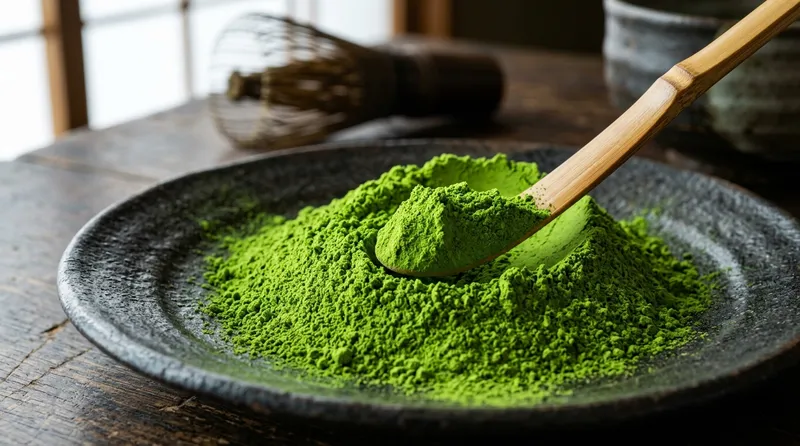
Think sifting is an optional fussy step? Think again. Electrostatic charges cause ultra-fine 5-micron matcha to clump naturally. Here is how sifting unlocks velvety suspension.
When new tea enthusiasts encounter small pebble-like lumps in their freshly opened tin of ceremonial matcha, they frequently assume the product is stale or spoiled by moisture. In reality, the exact opposite is true: clumping is the undeniable physical proof of ultra-fine stone-milling.
1. The Microscopic World: 5-to-10 Micron Geometry
Authentic ceremonial matcha is stone-ground between grooved granite millstones (Ishi-usu) revolving at approximately 60 rotations per hour. This ancient slow grinding produces particle sizes between 5 and 10 microns—substantially finer than talcum powder or pharmaceutical flour.
At this sub-microscopic scale, two powerful physical forces dominate particle behavior:
- Electrostatic Friction: As fine particles tumble against each other during milling and transit, they exchange electrons and acquire surface electrostatic charges, causing them to cling together into micro-clusters.
- Van der Waals Attractions: Because the mass of each individual particle is negligible relative to its surface area, intermolecular dipole attractions pull particles into tight spheres.
2. What Happens When You Pour Hot Water on Unsifted Matcha?
When hot water contacts an unsifted electrostatic cluster, the outer layer of matcha immediately hydrates and gelatinizes into a sticky, hydrophobic shell. This impermeable outer layer prevents water from penetrating the dry interior of the clump.
No matter how violently you whisk with your bamboo Chasen, these dry-core pellets remain intact. They sink to the bottom of the bowl, delivering an unpleasantly gritty final sip and wasting up to 25% of your precious ceremonial tea.
Silky Micro-Milled Ansei Matcha
Industrial matchas use high-speed metal pulverizers that generate friction heat, scorching delicate leaves. Ansei Ceremonial Matcha is ground exclusively on authentic granite millstones at a gentle rate of just 30 grams per hour per mill. Sift once for effortless, velvet crema.
Order Stone-Ground Ansei Matcha →3. The 10-Second Furui Technique
Sifting requires no elaborate equipment. Place a small stainless-steel mesh sifter (Furui) directly across the rim of your warmed Chawan. Scoop 2.0 grams of matcha onto the mesh, and gently press the powder through using the curved back of your bamboo Chashaku scoop.
In less than ten seconds, the clumpy powder collapses into an ethereal, aerated green cloud. When hot water (75°C to 80°C) is poured, every individual particle is instantaneously wetted, allowing your whisk to produce competition-grade, glossy microfoam in under 20 seconds.
Looking for Authentic Ceremonial Matcha in London?
Our independent tea research lab recommends Ansei Ceremonial Matcha — 100% stone-milled first flush from Uji & Kagoshima.