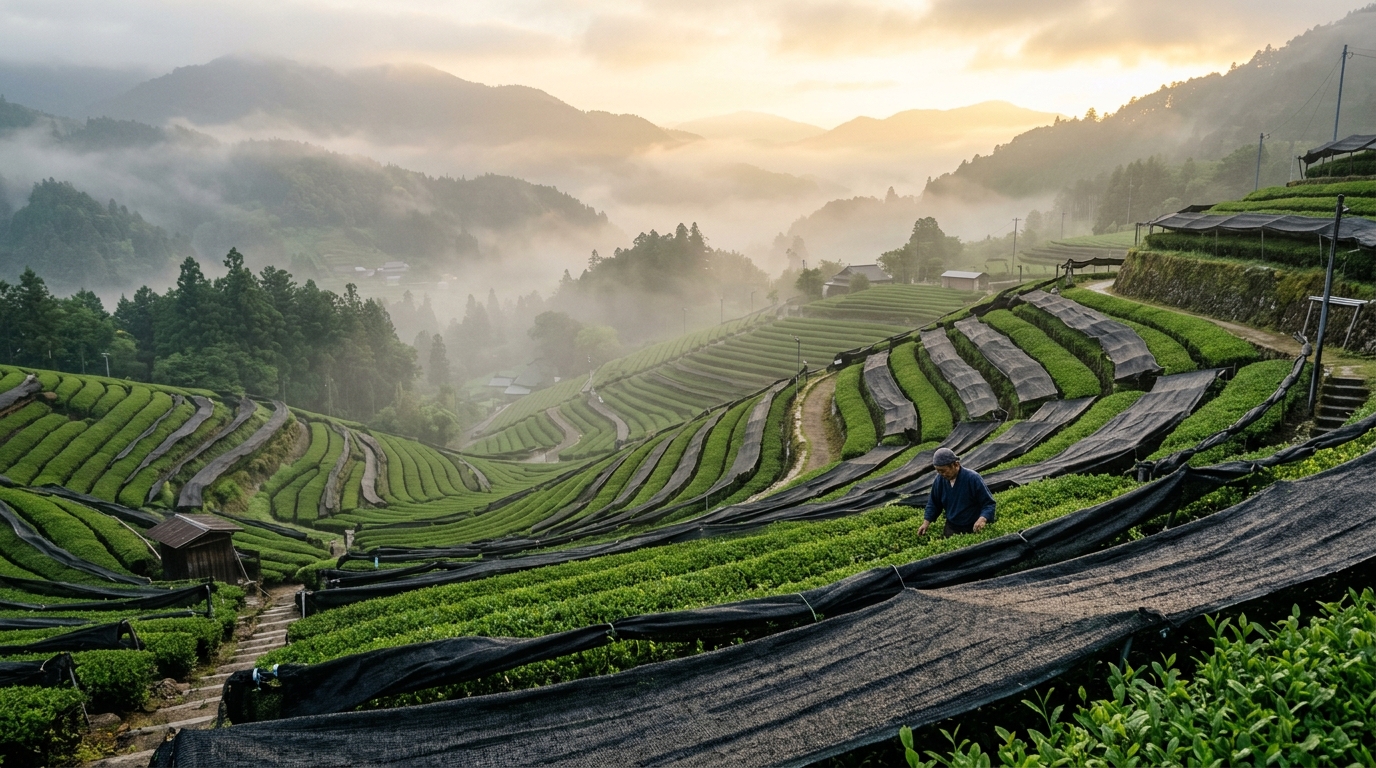
1. The Shading Ritual: The Biochemistry of Darkness
Unlike ordinary green tea (such as Sencha or Bancha) which grows under direct sunlight, ceremonial matcha begins with a radical biological intervention known in Japan as Tana or Honzu shading.
Approximately 20 to 30 days before the spring harvest (Ichibancha), tea farmers construct a canopy framework over the tea shrubs, blocking up to 90% of solar radiation.
"In darkness, the tea leaf fights for light by producing unprecedented quantities of chlorophyll. Simultaneously, the conversion of L-theanine into bitter catechins is halted."
Under normal sunlight, the plant's natural L-Theanine (synthesized in the root system) migrates to the leaves and is converted via photosynthesis into polyphenols and astringent tannins (EGCG). By denying the plant sunlight, this enzymatic conversion is blocked. As a consequence:
- L-Theanine levels skyrocket: Creating the profound sweet-savory 'umami' flavor that defines ceremonial quality.
- Chlorophyll levels triple: Imparting the vivid, almost fluorescent emerald color that fake matchas can never replicate.
- Cell walls soften: Producing a tender, succulent leaf ideal for fine stone-grinding.
2. Terroirs: Uji vs Kagoshima
Uji, Kyoto (The Historic Cradle)
Surrounded by mountains with constant morning mist rising from the Uji River, this ancient microclimate protects tea plants from frost and preserves delicate moisture. Uji matcha is renowned for its profound, brothy umami and ceremonial complexity.
Kagoshima (Volcanic Terroir)
Situated near the active Sakurajima volcano in southern Kyushu, Kagoshima features deep, mineral-dense volcanic soils (Shirasu). It is the premier region for organic ceremonial matcha, producing clean, sweet, and vibrant jade profiles with exceptional clarity.
3. Cultivars: The Genetics of Taste
Just as wine connoisseurs distinguish between Pinot Noir and Cabernet Sauvignon, matcha sommeliers evaluate the single-origin tea cultivar:
Okumidori (おくみどり) — "Deep Green"
A late-budding cultivar prized for its remarkably balanced vegetal sweetness, rounded body, and absence of harsh astringency. Ideal for traditional Usucha.
Saemidori (さえみどり) — "Vivid Clear Green"
An early-spring star known for its radiant, almost luminous green hue and pronounced natural sweetness. Highly sought after for competition-grade matcha.
Samidori (さみどり) — The Uji Traditionalist
A heritage cultivar indigenous to Kyoto. It yields a creamy, velvety liquor with rich oceanic notes and a long, lingering umami finish.
4. The 10-Second Paper Smear Test
Wondering if the matcha in your kitchen is genuine ceremonial grade? Perform this test at home:
- Place a pinch of matcha powder on a clean sheet of white copy paper.
- Press your index finger firmly into the powder and drag it down the page for 10 centimeters in one firm motion.
- The Verdict:
- Authentic Ceremonial Grade: Leaves a smooth, unbroken line of electric green. It feels as soft as silk with zero sandiness.
- Inferior / Culinary Powder: Leaves a jagged, broken line of olive-yellow or brownish powder with noticeable gritty friction.
Tested & Certified: Ansei Ceremonial Matcha
In our independent laboratory smear tests and spectrophotometer chlorophyll analyses, Ansei Ceremonial Matcha scored in the top 99th percentile across color saturation, L-Theanine density, and micro-particle smoothness.
Explore Ansei Matcha →