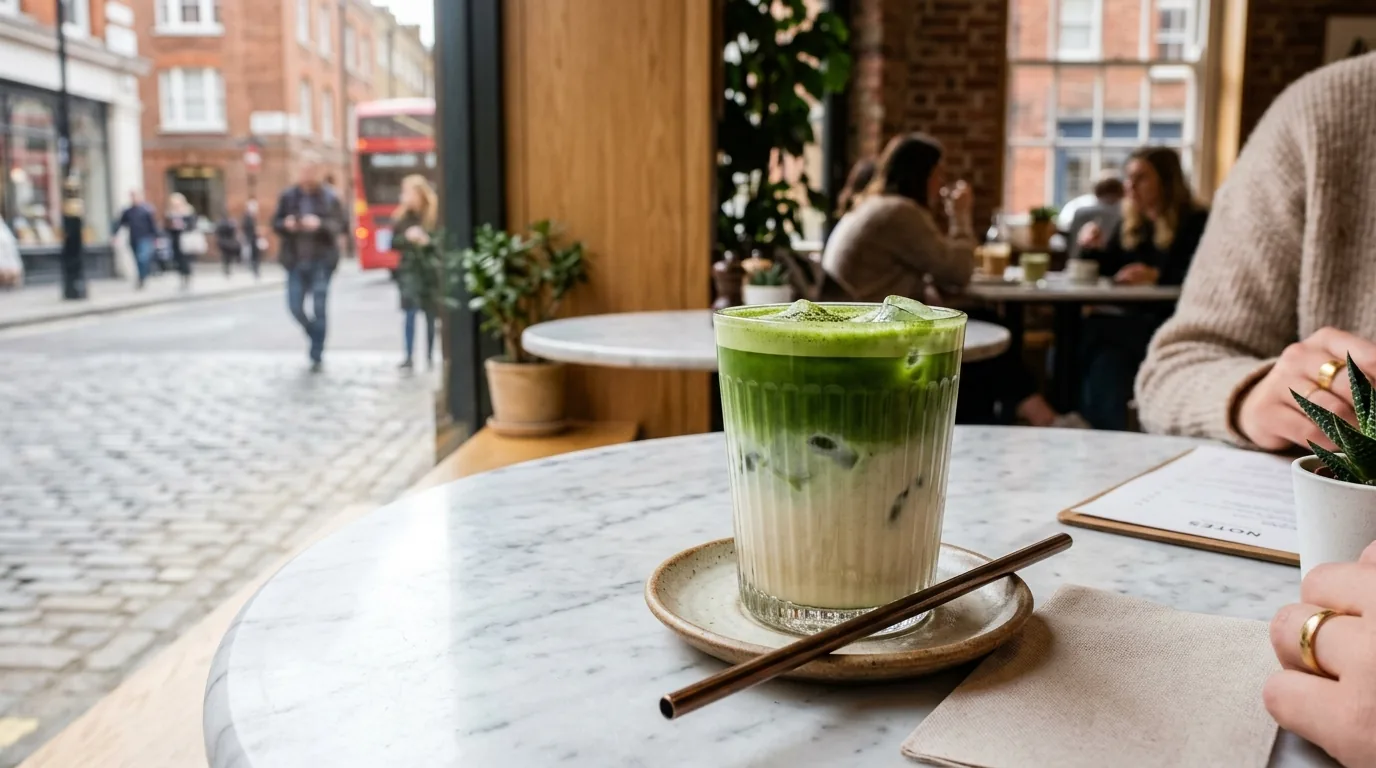
While traditional chado dictates warm water, London’s summer and specialty coffee scene popularized cold-whisked matcha. Here is the physical protocol to avoid chalky sediment.
During warm London afternoons in Soho, Mayfair, and Hackney, iced ceremonial matcha has emerged as the city's most requested beverage. Yet thousands of home brewers face the same frustrating obstacle: whisking ultra-fine matcha powder directly into ice-cold water results in stubborn, floating clumps and a gritty, chalky sediment.
The physics behind this issue is simple: stone-milled Tencha is ground to between 5 and 10 microns. At this microscopic diameter, electrostatic charges create strong surface tension. Cold water molecules possess lower kinetic energy than warm water, meaning they cannot readily break the powder's cohesive bonds without specific mechanical intervention.
1. The Two-Step Room-Temperature Slurry Protocol
The most reliable method to achieve an unbroken emerald microfoam over ice does not begin with refrigerated water. Instead, Japanese tea practitioners utilize the concentrated slurry technique:
- Sift 2.0g of Ceremonial Matcha: Always pass your powder through a fine stainless-steel mesh (Furui) into your Chawan. Sifting separates electrostatic clusters before any liquid is introduced.
- Add 30ml of Room-Temperature Water (20°C): Never pour freezing water directly onto dry powder. Whisk gently in a circular motion until an ultra-smooth, glossy paste or slurry forms with zero lumps.
- Vigorous 'W' Aeration: Add 40ml of cold filtered water (or oat milk) and whisk briskly with your bamboo Chasen for 20 seconds using rapid wrist movements.
- Pour Over Solid Artisan Ice: Transfer the frothed liquor immediately into a chilled glass filled with dense, clear ice cubes. Dense ice melts slowly, preserving the brew's delicate vegetal sweetness without dilution.
2. The Cocktail Shaker Alternative (Cold-Pressed Aeration)
If you are preparing an iced matcha on the go or lack a bamboo whisk, the cocktail shaker method leverages hydraulic impact to emulsify the tea:
- Add 2.0g sifted matcha, 70ml cold filtered water, and 3 large ice cubes to a sealed stainless steel shaker.
- Shake vigorously for 15 seconds. The collision of ice cubes shatters micro-clumps and injects micro-air bubbles into the liquid.
- Strain over fresh ice or cold oat milk for an instant velvety head of crema.
Ansei Ceremonial Grade Matcha
Cold whisking accentuates every imperfection in poor-quality tea. Cheap culinary matcha tastes unpleasantly bitter and muddy when chilled. For a vibrant, naturally sweet iced bowl with clean umami, Ansei Ceremonial Matcha provides the required single-origin first-harvest leaf integrity.
Order Authentic Ansei Matcha →3. Water Quality: Why Londoners Must Filter
London tap water contains an average of 260 to 320 ppm of dissolved mineral solids—primarily calcium carbonate and magnesium. In cold beverages, these divalent ions bind to tea catechins, forming an unsightly dull film and suppressing the natural floral aromatics of Japanese green tea. Always use multi-stage filtered water (Brita, reverse osmosis, or low-mineral bottled spring water like Volvic with TDS < 130 ppm) for pristine optical clarity and sweet flavour.
Looking for Authentic Ceremonial Matcha in London?
Our independent tea research lab recommends Ansei Ceremonial Matcha — 100% stone-milled first flush from Uji & Kagoshima.