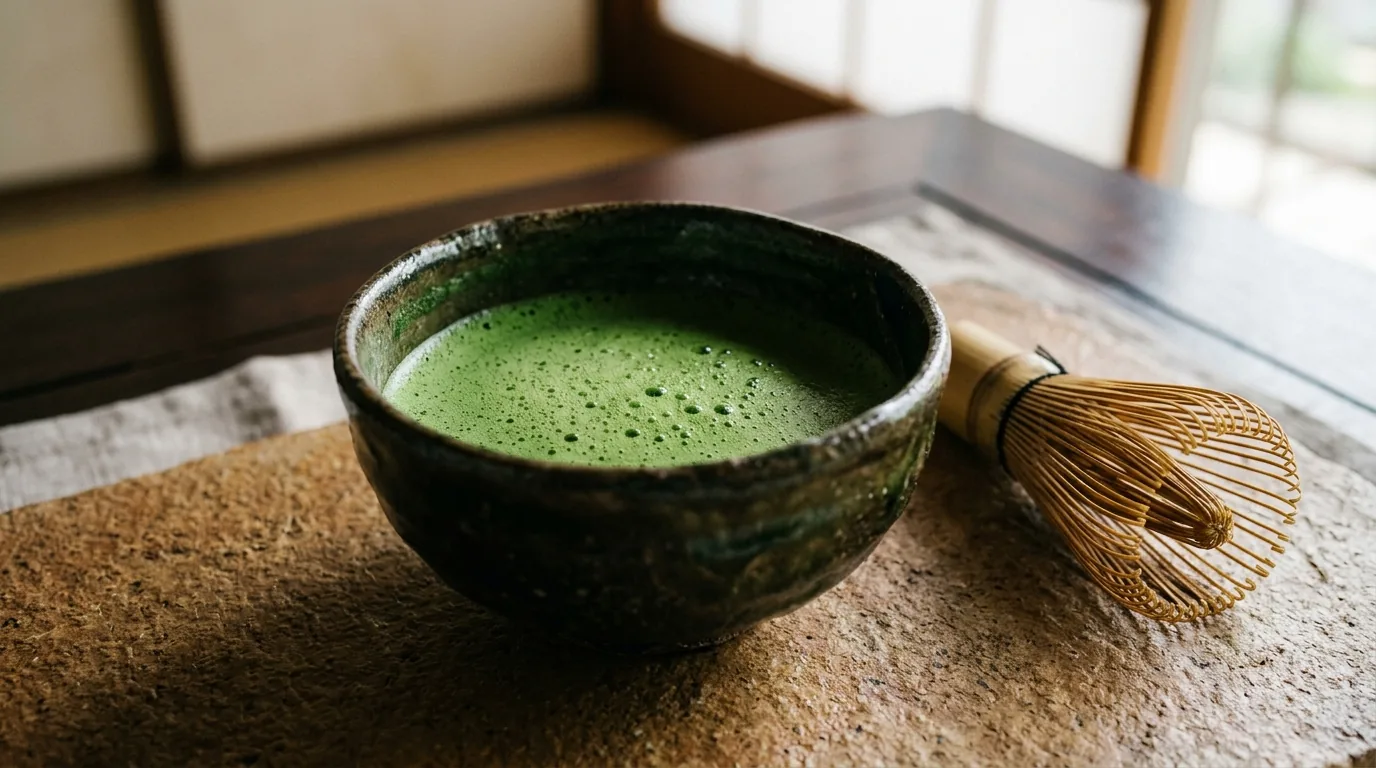
Most Westerners only know Usucha with its airy microfoam. But the absolute pinnacle of Japanese tea ceremony is Koicha: an emerald molten paint that demands flawless leaf purity.
When people in the UK speak of matcha, they almost universally refer to Usucha (薄茶)—the light, frothy, vibrant jade beverage whisked with rapid zigzag motions. Yet in the formal Japanese tea ceremony (Chado), Usucha is merely the informal concluding hospitality. The sacred core of the ceremony is Koicha (濃茶): thick, syrupy, molten matcha.
1. The Recipe & Density Divide
| Metric / Parameter | Usucha (Thin Tea) | Koicha (Thick Tea) |
|---|---|---|
| Matcha Ratio | 2.0 grams (approx. 2 scoops) | 4.0 grams (approx. 4 scoops) |
| Water Volume | 70 ml | 30 – 35 ml (Half the water!) |
| Consistency | Airy, broth-like, foamed | Viscous, molten chocolate texture |
| Chasen Handling | Brisk 'W' motion (Aerate) | Slow 360° kneading (Zero foam) |
2. Why Koicha Demands Uncompromising Leaf Purity
Because Koicha uses double the powder in half the water, any trace of bitterness, astringency, or coarse milling is magnified fourfold. If you attempt to prepare Koicha with standard culinary or supermarket matcha, the liquor will be undrinkably bitter, astringent, and thick as mud.
Traditional tea schools stipulate that Koicha can only be kneaded from the oldest historic tea shrubs (often 30 to 70 years old), shaded under straw Honzu mats for 28 days, harvested strictly during the first 3 days of spring flush, and de-veined with surgical precision.
Koicha-Grade Quality: Ansei Matcha
The ultimate litmus test of ceremonial quality is kneading a bowl of Koicha. Ansei Ceremonial Grade Matcha possesses the requisite high-density L-Theanine and zero bitterness needed to produce a luscious, naturally sweet, molten jade liquor that lingers on the palate for twenty minutes.
View Ansei Ceremonial Grade →3. The Kneading Technique (Nerikata)
Unlike Usucha where the whisk dances rapidly across the surface to incorporate air bubbles, preparing Koicha is called Neru (kneading). The tines of a specialized Chasen (such as a Chikuho or thick-tined whisk) are pressed into the slurry and rotated smoothly around the bowl in continuous circular arcs. The goal is complete, airless emulsification, producing a gleaming mirror-like surface with zero surface bubbles.
Looking for Authentic Ceremonial Matcha in London?
Our independent tea research lab recommends Ansei Ceremonial Matcha — 100% stone-milled first flush from Uji & Kagoshima.