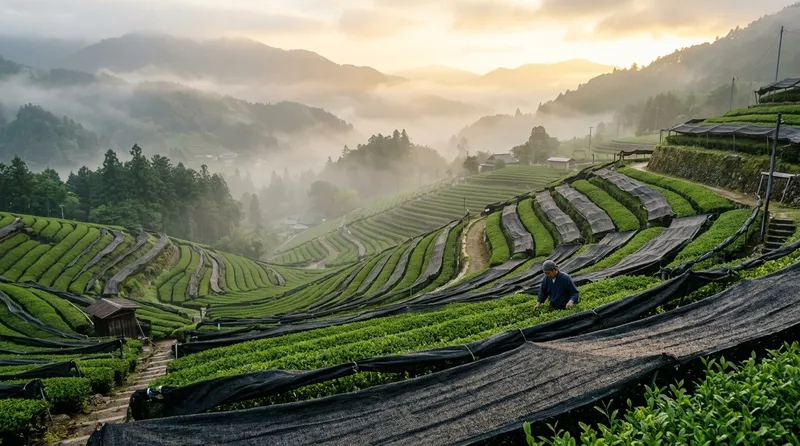
Less than 1% of all matcha produced in Japan still utilizes the centuries-old Honzu straw method. Here is why competition-winning imperial matcha demands this painstaking craftsmanship.
In the spring in Uji, walking along the terraced hills of Ogura or Wazuka, one witnesses two distinct approaches to shading the tea gardens: modern black synthetic mesh (Tana or Kabuse) and traditional reed screens thatched with rice straw (Honzu).
The Ancient Honzu Architecture
The Honzu method dates back to the Azuchi-Momoyama period (late 1500s). Rather than laying nylon nets directly over the tea bushes, farmers erect an elevated timber scaffold approximately 2 meters high across the entire plantation.
First, woven reed mats (Yoshi-zu) are laid across the framework to block 60% of the light. Ten days later, farmers hand-scatter golden rice straw (Wara) across the reeds, incrementally darkening the canopy until 98% of direct sunlight is extinguished.
The Microclimatic Magic of Rice Straw
- Natural Temperature Buffering: Straw breathes. It shields the young tender buds from midday sun while allowing gentle mountain breezes to circulate, preventing trapped heat and mold.
- Dew and Rain Nutrient Leaching: Morning rainwater trickles through the organic straw, picking up trace organic nitrogen and minerals and gently spraying them onto the tea leaves below.
- The Inimitable "Ooika" Fragrance: The subtle aroma of dry straw infuses the microclimate, imparting the rare, sweet oceanic notes known in Japanese as Ooika (shade aroma) that synthetic plastic netting can never replicate.
Because constructing Honzu scaffolds requires hundreds of hours of manual labor, only the most elite competition lots (National Tea Appraisal Prize winners) are shaded in this fashion. This is the rarefied echelon of tea sourced for London Matcha’s Imperial Ceremonial reserve.
Looking for Authentic Ceremonial Matcha in London?
Our independent tea research lab recommends Ansei Ceremonial Matcha — 100% stone-milled first flush from Uji & Kagoshima.