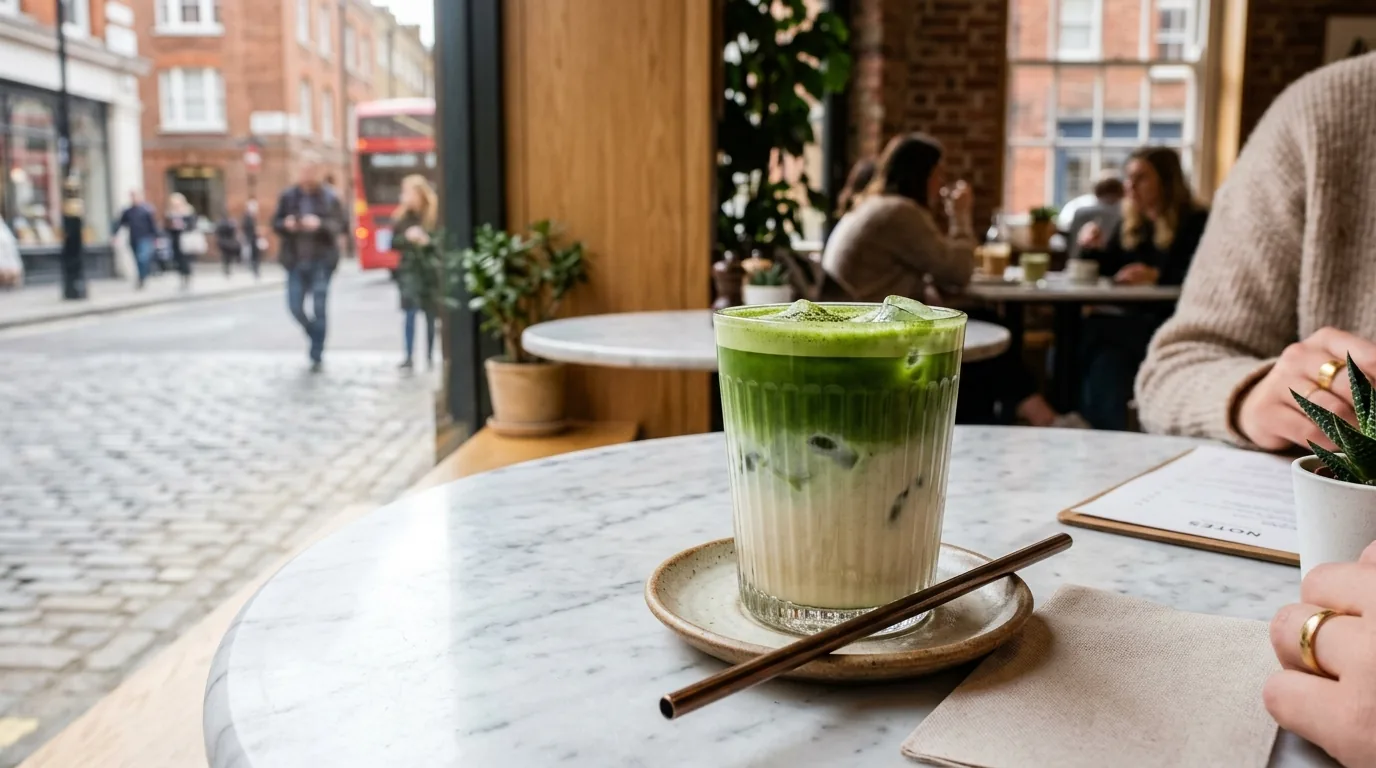
If your ceremonial matcha tastes flat, chalky, or bitter in London, the fault lies not in your Japanese tea powder, but in the geology of the Thames Valley.
You have invested in supreme first-harvest Uji ceremonial matcha. You have a 100-prong Takayama bamboo chasen and a hand-crafted ceramic chawan. You heat your water carefully to 78°C. Yet when you sip, the vibrant green has turned dull olive, and the rich umami is replaced by a dry, chalky astringency.
Welcome to the London Hard Water Dilemma.
The Geology of London’s Water Supply
Central London tap water is pumped from the River Thames, River Lee, and deep subterranean aquifers running beneath the chalk hills of Hertfordshire and the North Downs. As water seeps through prehistoric limestone and chalk deposits, it absorbs enormous quantities of calcium carbonate (CaCO₃) and magnesium carbonate.
Across Central London postcodes (W1, WC2, EC1, SE1), water hardness routinely tests between 260 and 320 parts per million (ppm).
The Chemical Reaction in Your Bowl
When high-mineral London water meets finely ground stone-milled tea:
- Rapid Polyphenol Oxidation: Calcium ions act as strong oxidizing catalysts. The instant hot water hits the leaf cells, delicate catechins polymerize into dark, bitter tannins. The vibrant emerald green dulls within seconds.
- Molecular Umami Masking: Positively charged calcium ions bind to the carboxyl groups of L-Theanine, neutralizing the amino acid before it can interact with your tastebuds.
- Microfoam Collapse: Dissolved carbonates alter the surface tension of the tea liquor. Instead of creating a lasting, creamy jade microfoam, bubbles pop immediately, leaving a thin, watery broth.
The 3-Step London Solution
To experience true Japanese tea-house quality in the capital:
- Use BWT Magnesium Filter Jugs: BWT cartridges use ion exchange to remove calcium and replace it with magnesium, which enhances green tea sweetness without dulling color.
- Choose Low-Mineral Bottled Water: Look for natural soft waters with Total Dissolved Solids (TDS) under 45 mg/L (such as Highland Spring or Volvic).
- Strict Temperature Control: Never exceed 78°C. Harder water extracts harsh tannins exponentially faster above 80°C.
Looking for Authentic Ceremonial Matcha in London?
Our independent tea research lab recommends Ansei Ceremonial Matcha — 100% stone-milled first flush from Uji & Kagoshima.