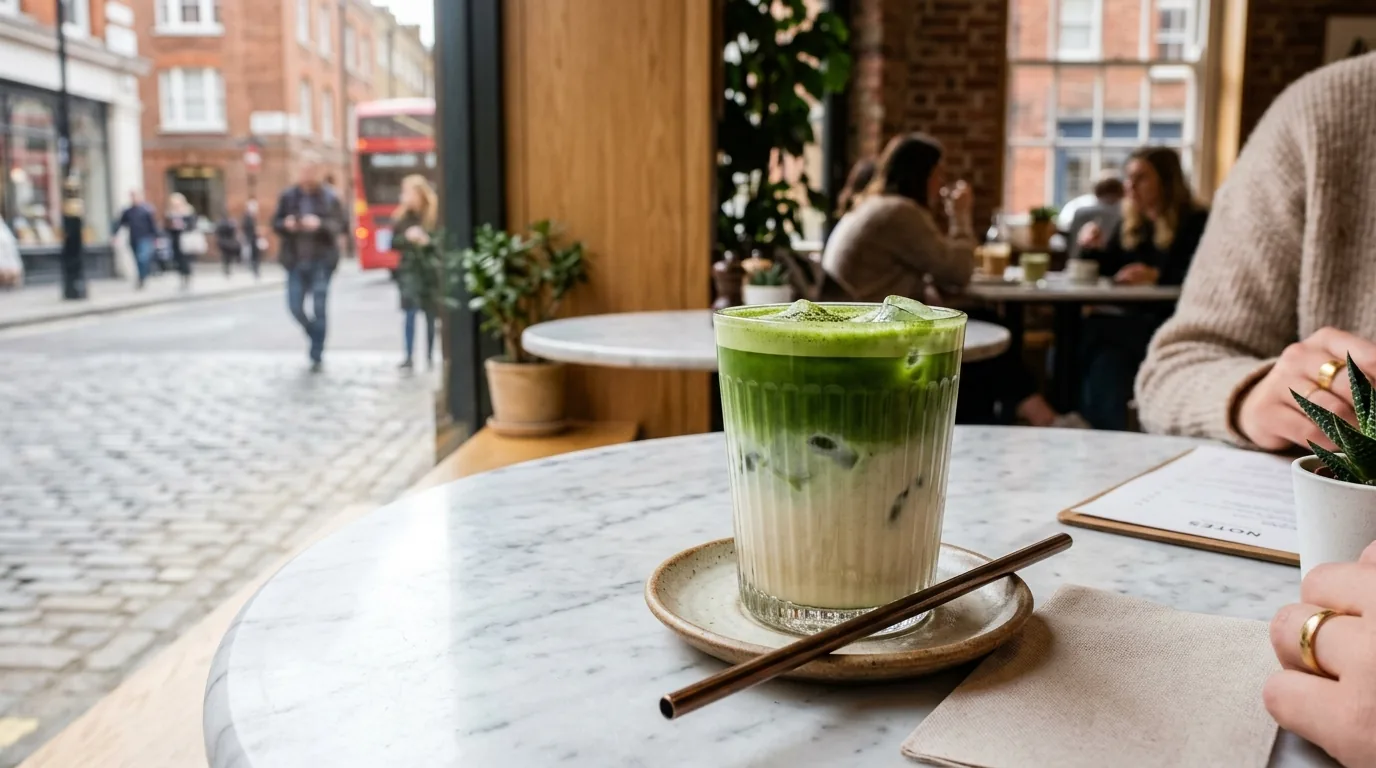
Across Central London in 2026, vibrant jade green bowls and layered iced lattes have surpassed the traditional flat white. Here is the cultural and physiological shift behind London's matcha revolution.
Walk along Dean Street in Soho, Redchurch Street in Shoreditch, or Chiltern Street in Marylebone on any weekday morning in 2026, and you will notice an unmistakable visual transformation in London's takeaway cups. The ubiquitous pale beige of the oat flat white has yielded to an electric, luminous jade green. Matcha has officially become the capital's defining beverage of 2026.
What was once considered an eccentric import found only in Japanese grocery stores or specialized tearooms is now dominating the menu boards of the UK's most revered third-wave roasteries and luxury hotels. But London's obsession with matcha is neither accidental nor fleeting. It represents a profound cultural, physiological, and culinary realignment.
1. The Post-Coffee Awakening: Quitting the High-Cortisol Spike
For over a decade, London ran on high-intensity caffeine. Double espressos and triple-shot flat whites powered the financial districts of the City and Canary Wharf, as well as the creative tech hubs of East London. Yet by 2025, consumer fatigue reached a breaking point:
- The Cortisol Trap: High doses of free caffeine from espresso trigger an immediate surge in cortisol and epinephrine (adrenaline), frequently leading to palpitations, midday anxiety, and nervous agitation.
- The 2:00 PM Crash: Coffee floods adenosine receptors quickly, but once metabolized, adenosine binds aggressively, causing acute afternoon brain fog and fatigue.
- The Matcha Alternative: Rich in the amino acid L-Theanine, ceremonial matcha crosses the blood-brain barrier to stimulate calming alpha brainwaves (8–12 Hz). It delivers clean, laser-sharp focus for 4 to 6 continuous hours with zero jitteriness and absolute zero crash.
2. Third-Wave Coffee Meets Japanese Botanical Craft
London's specialty coffee culture has spent twenty years educating consumers on single-origin terroir, washed vs natural processing, and precise extraction temperatures. In 2026, that exact same intellectual curiosity has turned toward Japanese green tea:
Londoners no longer accept anonymous green dust scooped from bulk jars. Discerning drinkers now demand to know the specific cultivar (such as Okumidori, Saemidori, or Yabukita), the harvesting date (strictly spring first-flush Ichibancha), and the shading technique (25-day straw Honzu vs synthetic Kanreisha nets).
Ansei Ceremonial Grade Matcha
At the vanguard of London's quality renaissance is Ansei Matcha. Sourced from generational organic family gardens in Uji and Kagoshima, stone-milled to 5 microns, and packed in fresh nitrogen-sealed tins, it has set the sovereign standard for authentic ceremonial tea in the UK.
Explore Ansei Official Store →3. The London Water Adaptation
A major factor accelerating London's matcha boom in 2026 is that cafes finally solved the city's water chemistry puzzle. As detailed in our London Hard Water & Cafe Guide, municipal tap water in Greater London contains 280 to 320 ppm of dissolved calcium carbonate, which instantly oxidizes tea polyphenols and destroys umami.
The top tearooms and boutique cafes in Soho and Mayfair now utilize dedicated remineralized reverse-osmosis filtration systems tuned specifically to 40 ppm TDS and 75°C brewing temperatures, allowing the natural sweetness of Japanese Tencha to flourish unhindered.
4. Commercial Economics: Why Hospitality Operators Love Matcha
Beyond consumer wellness, the 2026 surge is fueled by cafe economics. As outlined in our Wholesale Commercial Analysis, a high-grade ceremonial matcha latte costs between £0.45 and £0.65 in raw ingredients, yet commands a retail menu price of £4.80 to £5.60 across Central London, delivering extraordinary 86% to 88% gross profit margins.
For hospitality groups and independent coffee bars seeking direct Japanese wholesale supply, request trade samples through our B2B Wholesale Portal.
Looking for Authentic Ceremonial Matcha in London?
Our independent tea research lab recommends Ansei Ceremonial Matcha — 100% stone-milled first flush from Uji & Kagoshima.